Select a Country Site
Changing your site will take you to the URL for that ManpowerGroup location.
Entry-level hiring in the UAE is growing, but not evenly. According to the ManpowerGroup Employment Outlook Survey for Q4 2026, nearly half of UAE employers say hiring of entry-level workers is increasing compared with 2025. At the same time, a significant share are pulling back. The main reasons are cost pressure driving demand for experienced, immediately productive candidates, a broader slowdown in some hiring, and AI-driven automation reducing early-career roles and tasks. Entry-level hiring is not disappearing. It is being rethought.
Is entry-level hiring increasing in the UAE?
For many employers, yes. Nearly half of the 557 UAE employers surveyed expect to hire more entry-level workers than they did in 2025. This sits within a strong overall picture: the UAE’s Net Employment Outlook for Q4 2026 stands at 41%, and 51% of employers plan to increase headcount between October and December.
Which sectors are hiring the most entry-level talent?
The picture varies widely by industry. Utilities and Natural Resources leads, with 68% of employers increasing entry-level hiring. Hospitality follows at 63%. Construction and Real Estate and Trade and Logistics each sit at 52%. Professional, Scientific and Technical Services reaches 49%, with Finance and Insurance close behind at 48%. Information and Public Sector, Health and Social Services both report 43%. Manufacturing is the outlier: only 35% of employers are increasing entry-level hiring, while 48% report no change.
Why are some UAE employers pulling back on entry-level hiring?
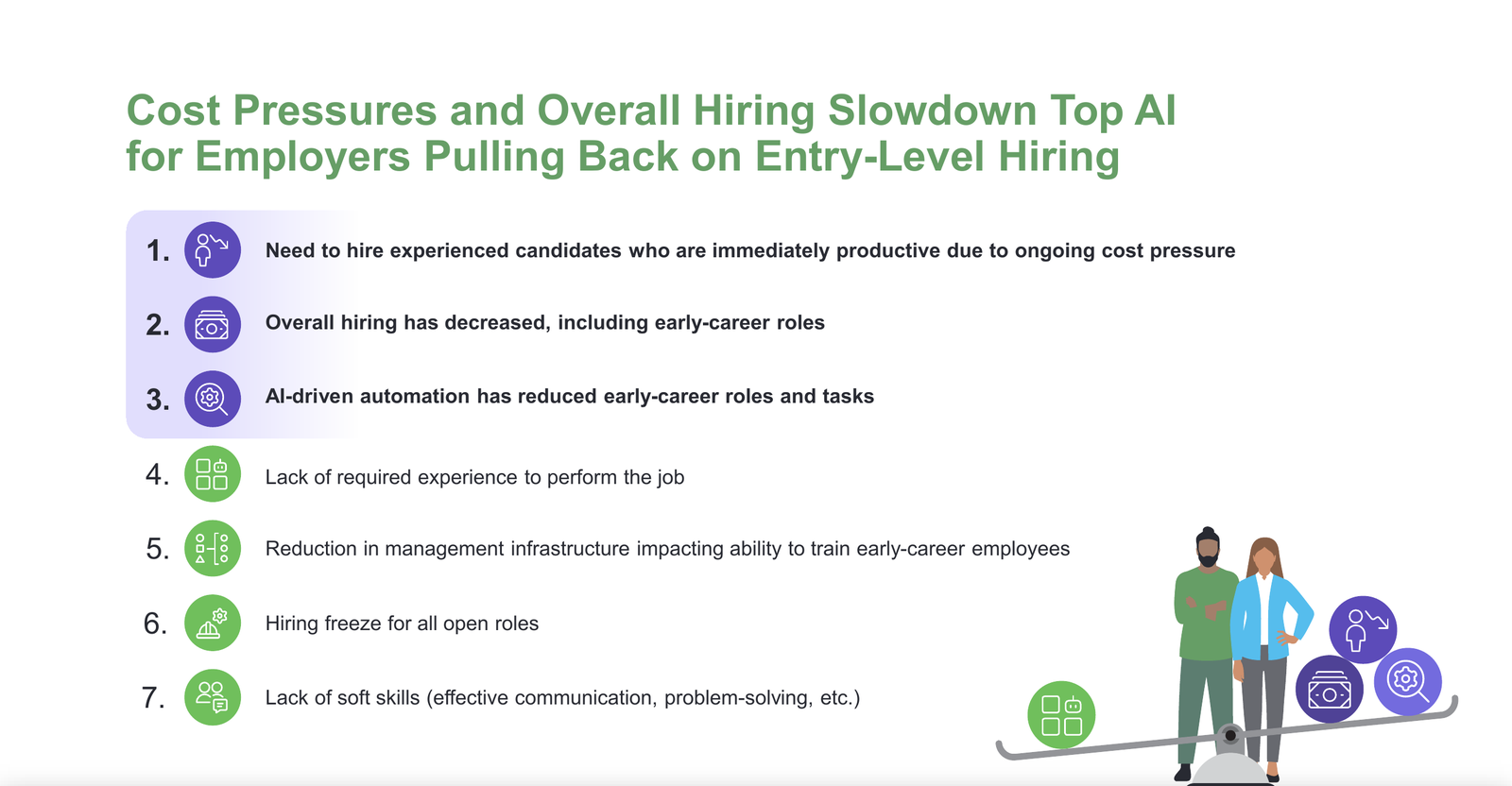
Employers reducing entry-level hiring ranked their reasons. In order:
The need to hire experienced candidates who are immediately productive, due to ongoing cost pressure
A decrease in overall hiring, including early-career roles
AI-driven automation reducing early-career roles and tasks
Candidates lacking the experience required to perform the job
Fewer managers available to train early-career employees
Hiring freezes on all open roles
A lack of soft skills such as communication and problem-solving
Cost pressure tops the list. When budgets are tight, employers favour people who can contribute from day one.
How big a role is AI playing?
A bigger one in the UAE than globally. UAE employers rank AI-driven automation as their third most important reason for pulling back on entry-level hiring. Across the global survey, it ranks fourth, behind a lack of required experience. That suggests UAE employers are moving faster to automate the routine tasks that early-career staff have traditionally handled. The survey does not show AI replacing entry-level roles outright. It shows those roles changing shape.
What does the training gap mean for employers?
The fifth-ranked reason deserves attention. Some employers say reduced management capacity is limiting their ability to train early-career employees. This links directly to the top reason: if no one has time to develop junior staff, experienced hires become the only option. That in turn adds pressure to the market for skilled talent, which UAE employers already name as their biggest hiring obstacle.
How can UAE employers make entry-level hiring work?
The survey points to the same factors that speed up hiring more broadly. UAE employers say better candidate targeting, closer collaboration between HR and hiring managers, faster internal approvals, recruitment technology and external recruitment partners all help them hire faster. For entry-level roles specifically, the barriers employers name are experience, training capacity and soft skills. Addressing those directly, through structured development and clearer role design, keeps early-career hiring viable even under cost pressure.
Frequently asked questions
Is entry-level hiring growing in the UAE? Nearly half of UAE employers say entry-level hiring is increasing compared with 2025.
Which sector is hiring the most entry-level workers? Utilities and Natural Resources, where 68% of employers report increased entry-level hiring.
Why are employers reducing entry-level hiring? The top reason is cost pressure driving demand for experienced, immediately productive candidates.
Is AI replacing entry-level jobs in the UAE? AI is reducing some early-career roles and tasks, and UAE employers rank it higher as a factor than employers globally. The data points to roles changing rather than disappearing.
Where does this data come from? The ManpowerGroup Employment Outlook Survey for Q4 2026, based on 557 UAE employers surveyed in July 2026.
Build your early-career talent strategy with ManpowerGroup Middle East
ManpowerGroup Middle East helps UAE organisations design hiring strategies grounded in quarterly employer research, from graduate intake to specialist and leadership roles. Speak to our team about building an early-career pipeline that works for your business.